

Two digital LED outputs, each with a power connection. Bring more of your lighting project together on a single controller.
Green screw-terminal blockINTRODUCING MAGWLED-2
MagWLED-2.
More built in.
A dual-output WLED controller with a built-in digital microphone and live power monitoring. More possibilities for your next lighting project.
DESIGNED FOR WLEDBUILT FOR YOUR NEXT IDEA

MORE POWER. MORE POSSIBILITIES.
More of what you wanted.
Less of what got in the way.
Reimagined from the circuit board up. The features you asked for, with room to do more.
EXPLORE THE HARDWARETOP SIDE


01 / 07 · Two independent outputsANNOTATED HARDWARE VIEWS
SCROLL OR SELECT TO EXPLORE
Negotiate up to 20V and 5A total over USB-C with a compatible Power Delivery supply and cable. Either channel can use up to 5A, within the shared limit negotiated with the supply. Match your power source to your LEDs and give your next installation more flexibility.
USB-C connectorFeel the music. See every beat. The onboard microphone brings audio-reactive WLED effects to life, with no separate microphone to wire in.
Underside microphoneThe dual-core ESP32-S3 delivers higher frame rates, especially for audio-reactive effects. An improved RF design helps WiFi performance, too.
Underside moduleSupply up to 24V and 10A total externally. Each channel supports up to 5A, with both channels sharing the 10A total limit. Fused and switched external power lets you cut power to the strips while the supply stays on.
Power fusesThe INA226 current-sensing chip and shunt resistor feed current, voltage and power data into WLED. Track your LEDs’ consumption continuously in the WLED UI, or bring those readings into Home Assistant and your automations.
Current · voltage · powerFive GPIO breakout pins and a Stemma QT I²C connector make room for buttons, sensors and new ideas. Keep USB-C connected for standby and external relay control.
GPIO header + Stemma QTENGINEERED ON BOTH SIDES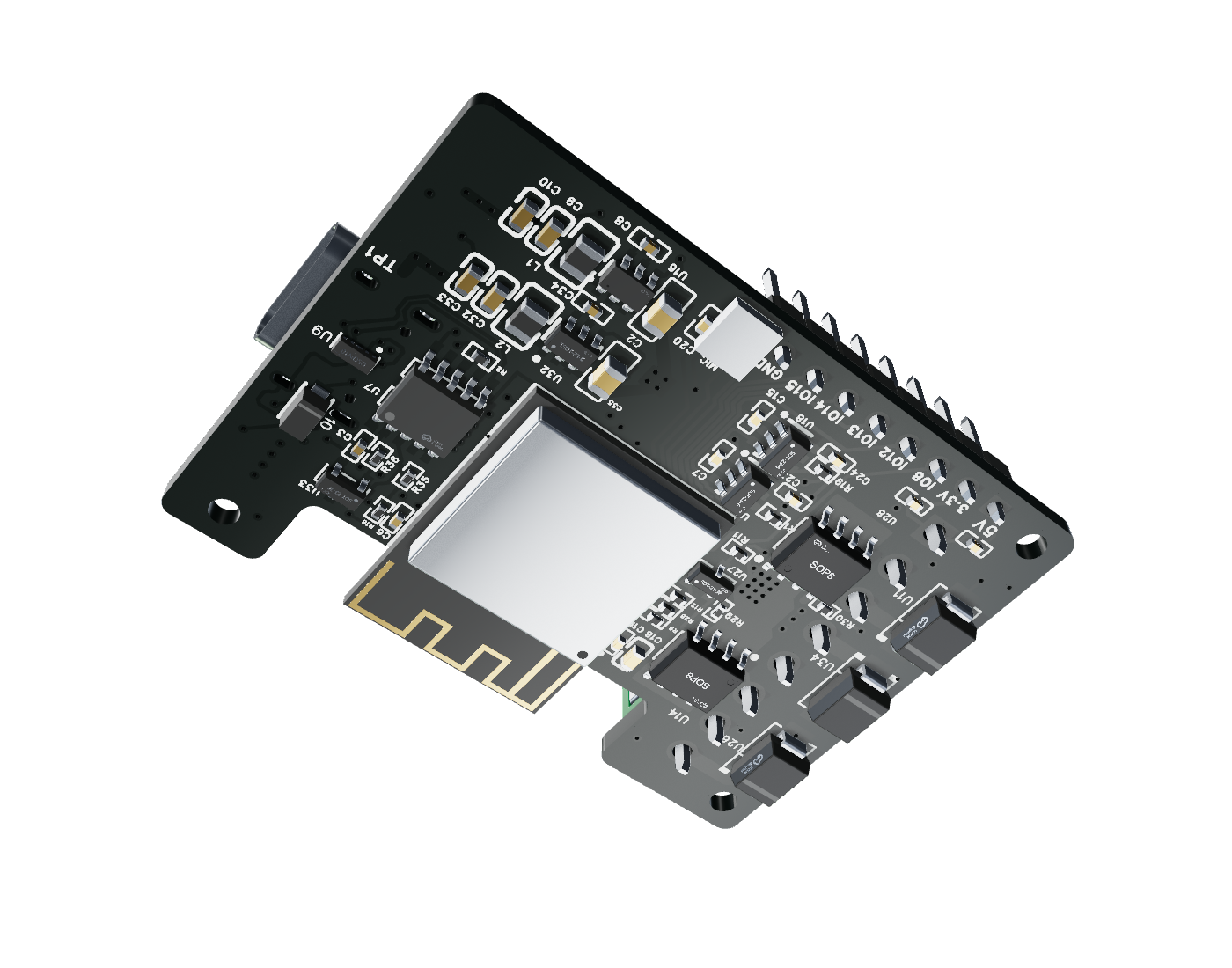
6 layers.Two sides. More on board.
MORE CAPABLE. MORE CONNECTED.
More on board.
More to build on.
A six-layer, two-sided PCB makes room for two outputs, a microphone and power monitoring.
01
Faster at its core.
The dual-core ESP32-S3 delivers higher frame rates, especially for audio-reactive effects. An improved RF design helps WiFi performance, too.
02
Ready for your next add-on.
Five GPIO breakout pins and a Stemma QT I²C connector make room for buttons, sensors, and new ideas. Dual buck converters supply the 3.3V and 5V rails.
03
Small details. Better builds.
Regular screw terminals simplify wiring. Keep USB-C connected alongside external power for standby and external relay control.
Specifications.
Power limits and connections, at a glance.
| Specification | MagWLED-2 |
|---|---|
| External power | Up to 24V DC · 10A total maximum (240W at 24V) |
| Per channel · external power | Up to 5A per channel; combined current across both channels must not exceed 10A |
| USB-C Power Delivery | Up to 20V · 5A total maximum (100W at 20V), capped by the negotiated USB-C PD limits |
| Per channel · USB-C | Up to 5A on either channel; combined current must stay within the negotiated supply limit, up to 5A total |
| Terminal wire sizes | 28–16 AWG · DORABO DB125-3.5-8P-GN-S screw-terminal block |
| LED outputs | 2 independent digital LED outputs, each with a power connection |
| Processor and audio | Dual-core ESP32-S3 · built-in digital microphone |
| Power monitoring | Current, voltage and power sensing integrated into WLED; readings available in the WLED UI and Home Assistant |
| Expansion | 5 GPIO breakout pins · Stemma QT I²C connector |
Each channel is limited to 5A. External power supports up to 10A total; USB-C supports up to 5A total, subject to negotiation. USB-C output depends on the power supply, cable and negotiated profile; 5A requires a 5A-capable USB-C cable. Match the voltage to your LEDs and choose wire suitable for the current and cable length. The terminal’s accepted wire range is not a current rating for every wire size. Terminal block datasheet.
Compare the controllers.
MagWLED-1 and MagWLED-2, side by side.
| The details | MagWLED-1The original | MagWLED-2Dual-output controller |
|---|---|---|
| LED outputs | 1 | 2 digital + power outputs |
| Processor | ESP32-C3 · single-core | ESP32-S3 · dual-core |
| USB-C Power Delivery | Up to 12V | Up to 20V · 5A total, subject to PD negotiation |
| External power input | Up to 12V | Up to 24V · 10A total · 5A per channel |
| Microphone | External add-on | Built in |
| LED connector | WAGO 2060 | Screw terminals · 28–16 AWG |
| GPIO breakout pins | 3 | 5 |
| I²C peripheral connector | No dedicated connector | Stemma QT |
| PCB construction | 4 layers · compact 48 × 32 mm | 6 layers · two-sided |
Also new: current, voltage and power sensing; fused and switched external power; USB-C standby; and dual switching converters. Read the full feature overview ↗
GOOD TO KNOW
A few bright
answers.
Does USB-C provide 24V?
MagWLED-2 negotiates up to 20V over USB-C with a compatible Power Delivery supply. The external power input supports up to 24V. The documentation notes that many 24V LED strips run at 20V, but check your strip’s requirements before choosing a power supply.
Do I need a separate microphone?
No. MagWLED-2 includes a built-in microphone for audio-reactive WLED effects. MagWLED-1 requires an external microphone.
Can I keep USB-C and external power connected?
Yes. MagWLED-2 supports both connections at the same time. USB-C can provide standby power, including for setups that control an external power relay.
What can I connect beyond LED strips?
Five GPIO breakout pins support sensors and buttons. The Stemma QT connector adds I²C peripherals such as time-of-flight sensors. Both the 3.3V and 5V rails use buck converters, with 500mA available from them in parallel as described in the documentation.
MEET MAGWLED-2
Make something
brilliant.
More outputs. More power. More possibilities.
That’s MagWLED-2.